
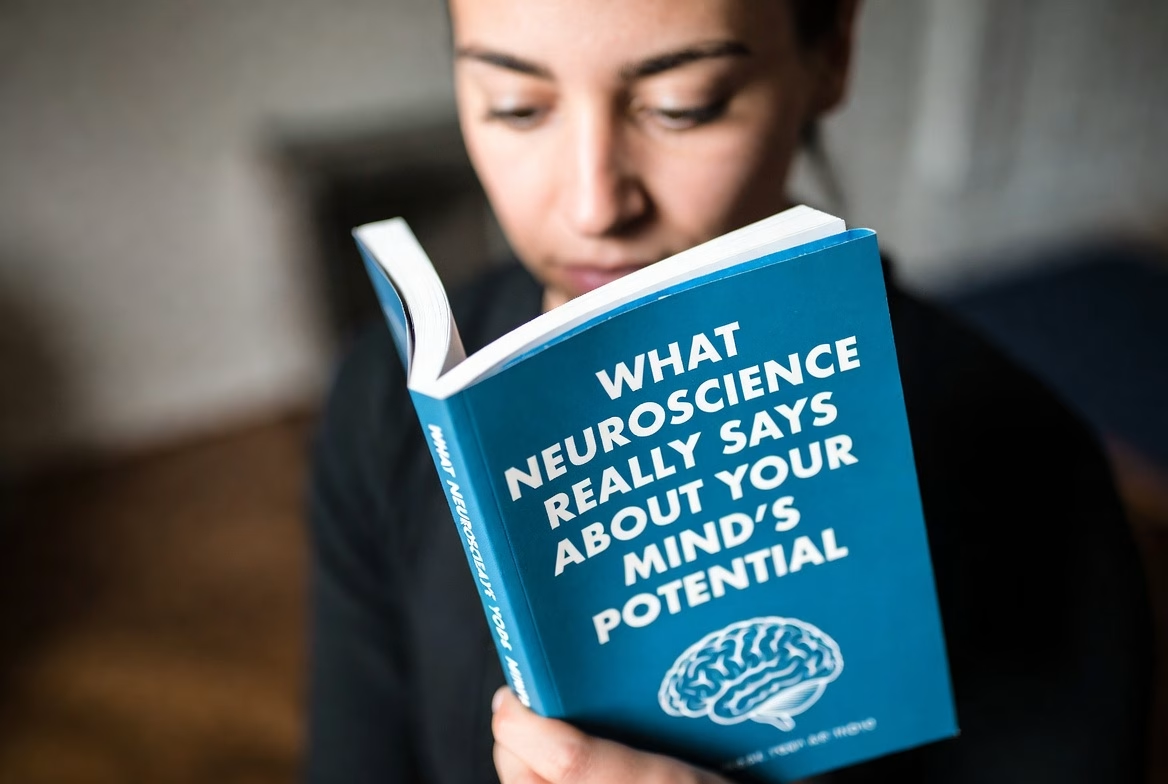
For decades, a compelling story has claimed we only use 10% of our brains. This idea suggests a vast reservoir of untapped potential lies dormant within our skulls. In reality, modern brain imaging shows we use virtually all of our brain every single day.
Key Takeaways
- The claim that humans only use 10% of their brains is a complete neuromyth with no scientific basis.
- Brain scans like fMRI and PET show activity coursing through nearly the entire organ, even during rest.
- The myth likely persists because it offers an appealing narrative of hidden human potential and easy self-improvement.
- Different brain regions have specialised functions, and not all areas are active at maximum intensity simultaneously.
- Even simple tasks like recalling a memory or making a cup of tea require coordinated activity across multiple brain networks.
- Damage to even a small area of the brain, like from a stroke, can lead to significant and lasting impairments.
- The brain is metabolically expensive, using about 20% of the body’s energy, making an unused 90% biologically wasteful.
- Understanding the myth helps us appreciate the brain’s true complexity and the real ways to support its health.
The Origin Of A Persistent Story
The exact source of the 10% figure is frustratingly murky. Some trace it to misinterpretations of early neuroscience. Researchers in the 1930s noted that only about 10% of the neurons in a brain slice appeared active at one time under their microscopes. This was a technical observation, not a statement on capacity. Others link the myth to motivational speakers or self-help gurus of the early 20th century. These figures may have used the statistic as a metaphor for untapped human potential. The idea offered a simple, inspiring message. It implied that greatness was not about hard work but about unlocking a secret part of yourself.
What Brain Scans Actually Show
Technology has given us a clear window into the working brain. Functional magnetic resonance imaging (fMRI) and positron emission tomography (PET) scans measure blood flow and metabolic activity. These scans consistently show that no healthy brain region is completely dark or inactive. Even when you are daydreaming or asleep, a network called the default mode network remains highly active. Performing a task, like talking or solving a puzzle, lights up specific, coordinated circuits. The takeaway is straightforward. Your brain is a constantly active, full-time organ, not a partially switched-off machine.
The Specialised Nature Of Brain Regions
The brain is not a general-purpose muscle that you can flex uniformly. It operates more like a sophisticated city with distinct neighbourhoods, each with a vital job. The visual cortex processes what you see. The motor cortex sends signals to your muscles. The hippocampus is crucial for forming memories. These areas do not all work at full throttle at the same time. Just as a city’s financial district is quiet at night while its residential areas are active, different brain regions cycle through periods of high and low activity. This efficient division of labour is a sign of advanced function, not underuse.
The High Cost Of A Powerful Brain
From a biological standpoint, the 10% myth makes little sense. The human brain is an energy hog. It constitutes only about 2% of body weight but consumes roughly 20% of the body’s oxygen and glucose. Evolution ruthlessly prunes inefficiency. Maintaining such a large, metabolically expensive organ with 90% of it doing nothing would be a tremendous waste of resources. It would offer no survival advantage. Natural selection would have favoured smaller, more efficient brains long ago. The brain’s high energy cost is strong evidence that every part of it serves a necessary purpose.
Why The Myth Refuses To Die
Despite the evidence, the myth remains popular in films, books, and casual conversation. Its endurance is not about facts but about psychology. The idea is incredibly appealing. It suggests we all possess a hidden genius waiting to be unleashed, often through a quick fix or secret technique. This narrative removes the pressure of sustained effort and learning. It also provides a handy, if false, explanation for personal limitations or failures. The myth persists because we want it to be true, offering hope of easy transformation.
The Real Dangers Of The Misconception
Believing in the 10% myth is not just harmless fun. It can lead to problematic attitudes and even enable scams. It devalues the amazing, continuous work the brain does to keep us alive and thinking. This misconception can also make people vulnerable to products falsely claiming to “activate” the unused portion of the brain, from dubious supplements to expensive training programmes. More broadly, it distracts from real, evidence-based ways to improve brain health and cognitive function. Understanding the brain’s true nature helps us care for it properly.
How To Support Your Whole Brain
Since you use your whole brain, supporting its overall health is the best strategy. Consistent cardiovascular exercise improves blood flow and can encourage the growth of new neurons. A balanced diet rich in omega-3 fatty acids, antioxidants, and vitamins supports neuronal function. Prioritising quality sleep is non-negotiable, as this is when the brain clears metabolic waste and consolidates memories. Engaging in lifelong learning and novel mental challenges strengthens neural connections. Managing chronic stress is also critical, as prolonged stress can damage brain structures involved in memory and emotion.
Conclusion
The 10% brain myth is a captivating story, but it is just a story. Neuroscience confirms that your brain is a fully engaged, always-on marvel of biological engineering. Every region has a role, and its constant activity is a sign of health, not waste. Letting go of this myth allows us to appreciate the brain’s true complexity. It shifts our focus from chasing fictional potential to practising real, daily habits that support cognitive vitality. The next step is not to unlock a hidden part of your mind, but to nourish and challenge the incredible whole brain you already use.
FAQ
Is any part of the brain unused?
No. Brain imaging studies show activity throughout the entire brain over a typical day. Different regions have specialised functions and become active at different times, but no significant area is permanently dormant or without purpose.
Where did the 10% myth come from?
The origin is unclear but likely stems from a mix of sources. These include misinterpretations of early neurological research and its adoption by motivational speakers in the early 1900s. They used it as a powerful metaphor for untapped potential, not a scientific fact.
If we use 100% of our brains, what does that mean for intelligence?
It means intelligence and skill are not about accessing unused brain matter. They result from the strength and efficiency of connections between neurons, the richness of your neural networks, and the knowledge you build through experience and learning.
Can brain training games unlock more of my brain?
Brain training games often improve your skill at that specific game. However, they do not “unlock” dormant brain regions or broadly increase general intelligence. For overall brain health, diverse activities like learning a language, exercising, and socialising are more beneficial.
What happens if a small part of the brain is damaged?
Even damage to a very small, specialised area can have severe consequences. A stroke affecting a part of the motor cortex can cause paralysis. Injury to a speech centre can lead to aphasia, impairing the ability to speak or understand language. This demonstrates that all parts are essential.
Does the myth appear in popular culture?
Yes, it is a common trope. Many films and books use the idea as a plot device, suggesting characters can gain psychic powers or super-intelligence by accessing the other 90%. These stories have significantly helped cement the myth in the public imagination.
How can I improve my brain’s performance?
Focus on foundational health: regular aerobic exercise, a nutrient-rich diet, seven to nine hours of sleep per night, stress management, and continuous engagement in new and complex learning activities. These practices support the brain’s natural plasticity and overall function.
Do other animals use more or less of their brains?
All animals with complex nervous systems use the entirety of their brains. The size and structure differ, but the principle of full utilisation holds. An animal’s brain is adapted to its ecological niche, with all parts contributing to its survival and behaviour.
Leave a Reply