
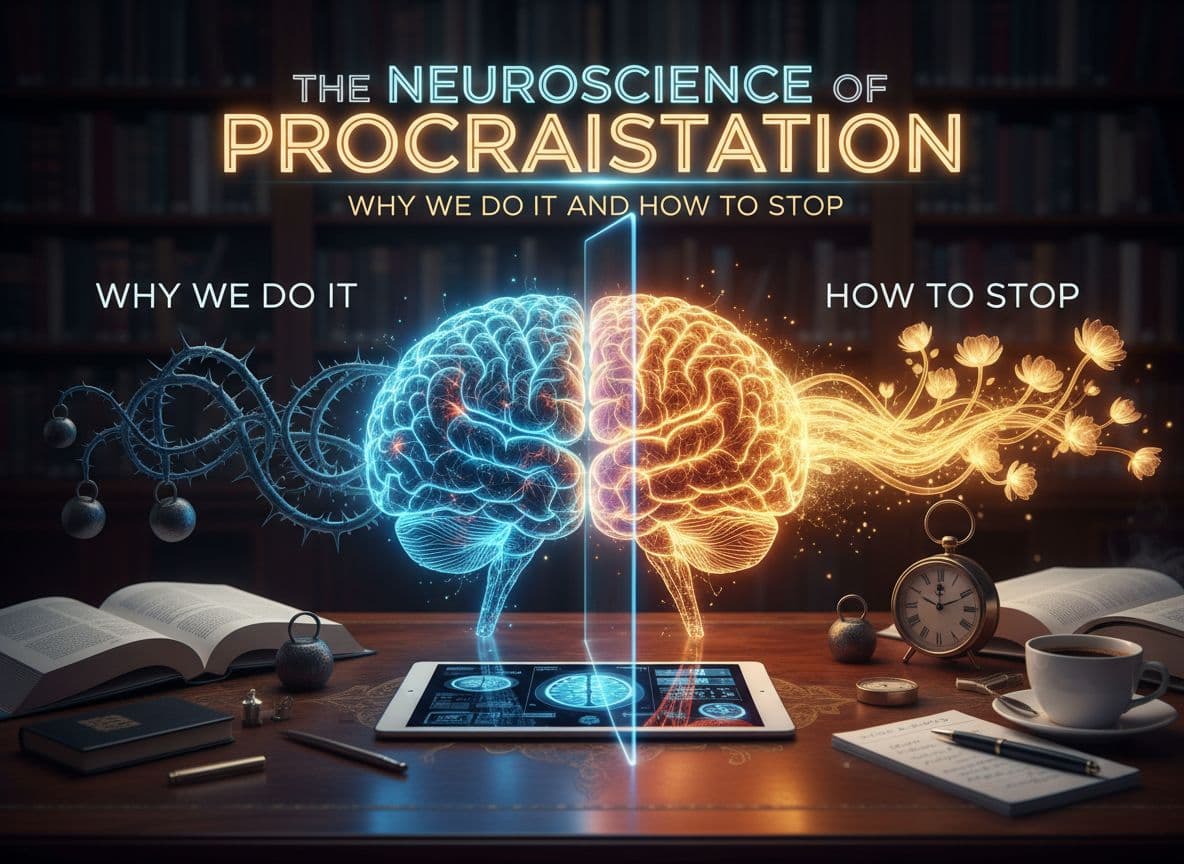
About 20% of adults are chronic procrastinators, and many more put things off most weeks. That’s a lot of people staring at the same email draft, unopened bank letter, or half-started assignment.
If that sounds familiar, the useful point is this: procrastination is rarely a character flaw. It’s often a brain and emotion problem. Your mind grabs quick relief now, even when it costs you later.
This article keeps it simple and shame-free. You’ll learn what procrastination really is, what happens in the brain (fast feelings vs smart planning), and a practical plan you can use today.
Key Takeaways
- Procrastination is delaying an intended task even when you expect it’ll make things worse later.
- It often works like mood repair, because avoiding a task reduces stress in the moment.
- Your brain discounts the future, so long-term rewards feel faint compared with quick comfort now.
- Dopamine drives motivation and learning, so phones and snacks often beat slow, effortful tasks.
- Make the first step tiny, because starting is the hardest part for your nervous system.
- Use short sprints (10 to 25 minutes) to make work feel safer and more doable.
- Try if-then plans (implementation intentions) so you don’t rely on willpower at the key moment.
- Reward effort, not just outcomes, so your brain learns that showing up pays off.
- Change your environment to add friction to distractions and reduce “self-control battles”.
What Procrastination Really Is (And Why It Feels So Hard To Stop)
Procrastination isn’t just “not doing the thing”. It’s choosing to delay a task you meant to do, while knowing the delay will likely hurt you. That could mean more stress, worse work, fees, or a weekend lost to last-minute panic.
That definition matters because it separates procrastination from rest. Rest helps you recover and returns you to the task stronger. Procrastination tends to leave a mental tab open, humming in the background.
Before you label yourself, it also helps to separate procrastination from smart delay. Sometimes waiting is the right move, because you need more information, a reply, or the right tools.
Here’s a quick way to tell them apart:
| Behaviour | What It Looks Like | What It Leads To |
|---|---|---|
| Rest | You choose a break, then return | More energy and steadier focus |
| Smart delay | You wait for a reason, with a plan | Better timing and fewer mistakes |
| Procrastination | You avoid, then feel stuck or guilty | Stress, rush, and lower confidence |
Guilt often keeps the loop going. You put it off, feel bad, then avoid the bad feeling by putting it off again. Over time, your brain starts to link the task with discomfort, even if the task is normal.
Procrastination Is Often Mood Management, Not Time Management
People often procrastinate because the task triggers a feeling they don’t want. Boredom, anxiety, self-doubt, frustration, even resentment can all push you away from the work.
Avoiding the task brings quick relief. That relief is a reward, even if it’s small. Your brain learns, “When I dodge this, I feel better.” Next time, the urge to avoid arrives faster.
That’s why advice like “just manage your time” can fall flat. You can have a perfect schedule and still avoid the one task that makes your stomach tighten.
Procrastination often isn’t about laziness, it’s about escaping discomfort quickly.
The Hidden Costs: Stress, Sleep, And Last-Minute Work
The costs are usually quiet at first. A delayed email becomes a harder email. A missed workout becomes “I’ll start next week”. Then the backlog grows, and so does the stress.
Rushing near deadlines also changes how you work. You take fewer creative risks, check less, and settle for “good enough” in a panicked way. Even worse, repeated last-minute sprints can train your brain to wait for pressure before it acts.
Sleep can take a hit too. Bedtime procrastination is common, because the evening finally feels like “your time”. Scrolling buys a bit of comfort, yet you wake up tired, and tired brains procrastinate more. Stress can also raise hormones like cortisol, which can make focus and memory feel harder the next day.
The Neuroscience: The Tug Of War Between Fast Feelings And Smart Planning
It helps to picture procrastination as a tug of war. One side wants comfort now. The other side wants a better future.
The “fast” side involves the limbic system, which reacts to emotion and reward. It’s quick, protective, and very persuasive. The “planner” side involves the prefrontal cortex, which supports focus, self-control, and long-term decisions.
When you face a tricky task, your brain does a rapid cost check. If the task feels unpleasant or uncertain, avoidance looks attractive. On top of that, we naturally discount future rewards. Psychologists call this temporal discounting. A benefit next week feels less real than a nice feeling right now.
Modern distractions make this worse. Your attention goes where rewards are easy to get. A phone offers instant novelty, feedback, and social cues. Meanwhile, a report offers delayed reward, and a bit of effort pain upfront.
Amygdala And The Limbic System: When A Task Feels Like A Threat
The amygdala helps detect threat. That threat can be physical, but it can also be social or emotional. A task can feel risky if it might expose you to judgement, failure, or conflict.
That’s why avoidance often targets “adult admin”. Opening a bill can trigger worry. Starting an essay can trigger fear of not being good enough. Making a difficult call can trigger discomfort about how the other person will react.
Your brain isn’t trying to ruin your day. It’s trying to reduce a stress signal. The problem is that avoidance teaches the amygdala that the task truly was dangerous, because you “escaped” it.
Prefrontal Cortex: The Part That Plans Can Get Overruled
The prefrontal cortex acts like a manager. It helps you hold a goal in mind, ignore distractions, and take the next sensible step.
That manager gets weaker when you’re tired, stressed, hungry, or overloaded. Decision fatigue is real in daily life. After a long day of choices, the brain looks for the easiest path.
Some research suggests chronic procrastination relates to differences in brain systems tied to self-control and emotion regulation. That doesn’t mean you’re stuck. It means your brain may need better conditions and better tools than “try harder”.
Dopamine, Rewards, And Why Scrolling Beats Starting
Dopamine often gets called the pleasure chemical, but that’s only part of the story. It’s more like a motivation and learning signal. It helps your brain notice what’s rewarding and pushes you to repeat it.
Quick hits win because they’re immediate and predictable. A notification, a short video, or a snack gives fast feedback. Big tasks feel vague, and the reward sits far away.
A simple fix follows from this: make the first step small enough that starting becomes rewarding. Once you begin, you create progress, and progress feeds motivation.
Why You Procrastinate In Real Life: Common Triggers You Can Spot Fast
The brain story becomes useful when you can spot your patterns quickly. Most procrastination triggers fall into a few buckets. When you name the bucket, you can choose the right tool, instead of guessing.
Think of this like noticing the weather before you leave the house. You don’t shame yourself for rain. You grab a coat.
The Task Is Too Vague Or Too Big To Start
Vague tasks create uncertainty, and uncertainty feels uncomfortable. “Do the finances” has no clear first move, so your brain stalls. The same goes for “write the report” or “revise for the exam”.
Clarity beats motivation here. Turn the task into a first action you can see. “Open the spreadsheet and find last month’s invoices” is clearer. “Write three bullet points under the heading” is also clear.
Once the first action is real, the second action often appears on its own. You don’t need a full plan, just a doorway into the work.
Perfectionism, Fear Of Failure, And Fear Of Success
Perfectionism often looks like high standards, but it behaves like fear. If the work must be brilliant, starting feels risky. Your brain chooses safety, so you wait for the “right time”.
“I’ll do it when I have more time” sometimes means “I want it to be perfect”. That thought protects your self-image today, yet it steals your progress tomorrow.
A better frame is to aim for a rough first pass. First drafts exist to be messy. You can’t edit a blank page, but you can always edit bad work.
Low Energy States: Sleep Debt, Stress, And Decision Fatigue
Low energy changes your brain’s priorities. When you’re tired, you crave comfort and predictability. That’s when procrastination feels almost automatic.
Stress adds another layer. If your body feels tense, the mind looks for relief. You might snack, scroll, tidy, or start a “quick” side task that seems productive.
Basic supports help more than people expect. Sleep, protein, water, daylight, and a short walk are brain fuel. They aren’t moral discipline, they’re maintenance.
How To Stop Procrastinating: A Brain-Friendly Plan That Actually Sticks
You don’t need a new personality. You need a plan that reduces threat, lowers friction, and builds better rewards. Try two strategies for a week, then keep what works.
Make Starting Tiny: The 2-Minute Entry Point
Set a rule: you only have to do two minutes. This bypasses the “this will be awful” signal, because two minutes feels safe.
Examples help:
- Work: open the email, write the subject line, add one sentence.
- Study: open the notes, write three questions you need to answer.
- Home admin: find the letter, place it on the table, open it.
After two minutes, you can stop. That’s not failure, it’s the plan. In practice, starting often creates momentum, so you keep going by choice.
Use Short Sprints: Pomodoro And The 10-Minute Timer
Time boxes make work feel contained. The task stops being an endless tunnel, and becomes a short walk with a clear end.
A classic Pomodoro is 25 minutes work, 5 minutes break, then repeat. If that feels heavy, use 10 minutes for high-resistance tasks. The goal is to keep the bar low enough that you begin.
When the timer ends, make one calm decision. Continue for another sprint, or stop without guilt and schedule the next sprint. This avoids the all-or-nothing trap.
Plan The Moment: If-Then Plans That Remove Choice
Implementation intentions work because they reduce decision-making at the key moment. You aren’t asking “Should I start now?” You’re following a script.
Use a clear format: If (time and place), then (first action).
Here are three examples:
- If it’s 08:30 and I sit at my desk, then I open the document and write the title.
- If I make a cup of tea after lunch, then I set a 10-minute timer and start the hardest admin task.
- If I get home and put down my keys, then I change clothes and walk for 10 minutes.
Keep it simple and repeatable. A good if-then plan feels almost boring, and that’s the point.
Rewire Reward: Reward Effort, Not Just The Finish Line
If your brain only gets a reward at the end, it will avoid starting. Build small rewards into the process, because effort needs payoffs too.
A good reward is short and doesn’t steal attention. Tea, a quick stretch, a short walk, or one song can work well. Save high-hook rewards, like social media, for planned times, or they’ll turn into a 90-minute detour.
Pair the reward with a clear rule: “After 15 minutes of work, I get five minutes of break.” Over time, your brain links effort with something positive, not just pressure.
Change The Environment So Your Brain Has Fewer Battles
Willpower is unreliable, so design helps. Your environment can either feed procrastination or starve it.
Start with the easiest wins. Put your phone in another room, or at least out of reach. Turn off non-essential notifications. If you work on a computer, use website blockers during sprints, and try a single-tab rule.
Also reduce setup friction. Lay out materials the night before. Keep your work surface clear. These changes add micro-costs to distractions, so your “manager brain” has time to step in.
FAQ
Is procrastination the same as being lazy?
No. Laziness suggests you don’t care, while procrastination usually comes with stress and guilt. In many cases, you care a lot, which is why the task feels loaded. Treat it as a behaviour pattern you can change, not an identity.
Can procrastination be caused by anxiety or depression?
It can overlap with both. Anxiety can make tasks feel threatening, while depression can reduce energy and hope. If procrastination feels severe, persistent, or linked to low mood, support from a GP or therapist can help.
How long does it take to break a procrastination habit?
It varies, because habits sit on top of your workload, stress, and sleep. Many people notice improvement within a few weeks of steady systems. Focus on repeating small starts, because consistency beats big motivational swings.
Do Pomodoro timers really work for everyone?
They help many people because they reduce overwhelm and create a clear finish point. Still, they may feel tricky for deep work, ADHD traits, or high anxiety days. In that case, use a flexible version, such as 10 or 15 minutes.
What is the fastest way to start when I feel stuck?
First, take one slow breath and relax your shoulders. Next, name the next tiny step, then set a 10-minute timer. Finally, remove your phone and start badly on purpose, because messy work beats no work.
Should I do the hardest task first or warm up with an easy one?
Hardest first can cut dread and stop the task haunting you all day. On the other hand, an easy win can build momentum when energy is low. Choose based on your energy, deadlines, and what you’ve been avoiding most.
How do I stop procrastinating on my phone?
Make the phone harder to reach during work blocks, ideally in another room. Use Focus modes, switch off non-essential alerts, and set app limits. In addition, plan phone breaks, so your brain doesn’t feel deprived.
What is ‘active procrastination’, and is it a good thing?
Some people delay on purpose and still meet deadlines, often because pressure boosts focus. It can work, but it’s risky and stressful, and quality can suffer. Test it honestly by tracking results, sleep, and stress, not just whether you finished.
Conclusion
Procrastination is often a brain pattern where short-term relief beats long-term goals. That doesn’t make you weak, it makes you human. With tiny starts, better rewards, and fewer triggers, the pattern can change.
Pick one task today. Define the first 2-minute action, set a timer, and begin, even if it’s messy.
Leave a Reply