
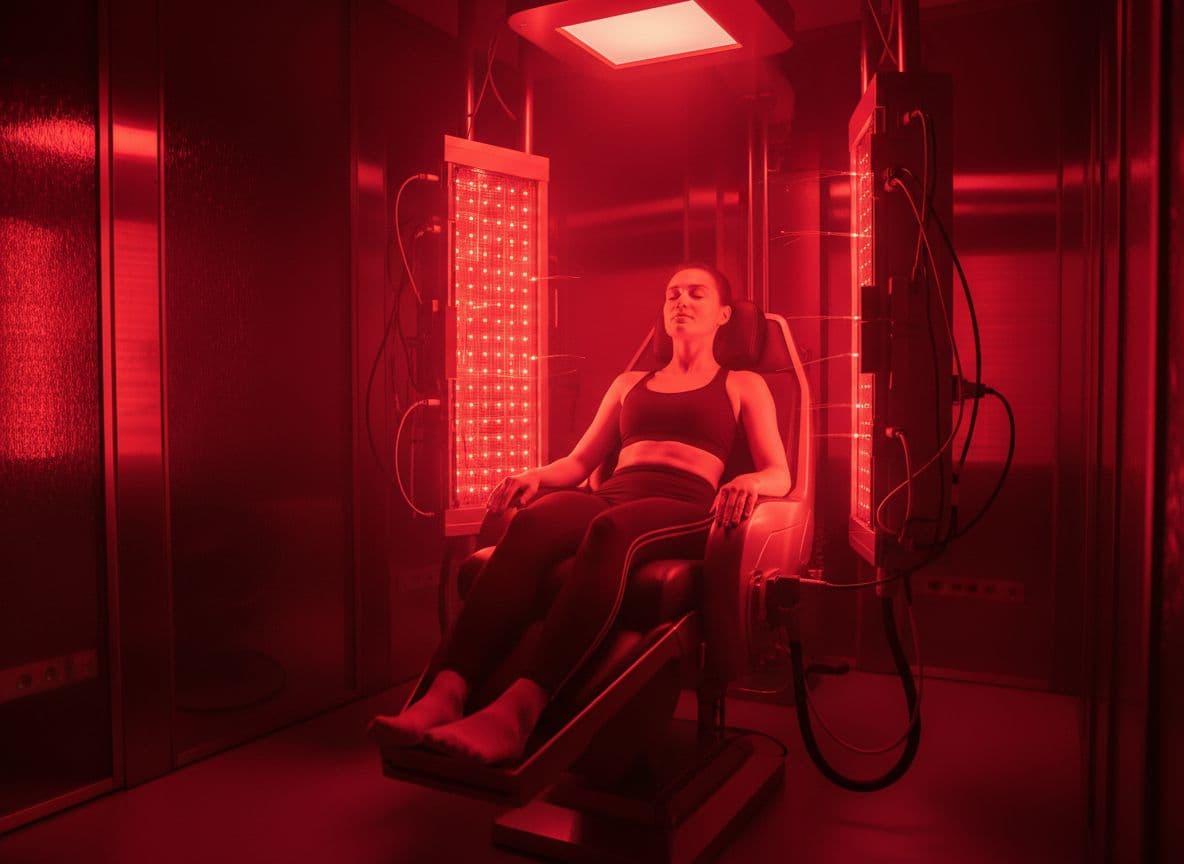
Red light therapy turns up in real clinics, not just on social media, but the most popular promises often outpace what studies can prove.
In plain terms, red light therapy (RLT) means exposing the body to red and near-infrared light, usually from LEDs, for a set time and distance. The idea is simple, but the evidence varies a lot by use case.
This article keeps it data-first and hype-free. It’ll explain how RLT is thought to work, summarise what research shows for common goals (and where it doesn’t), then finish with practical safety and buying guidance you can use at home.
Key Takeaways
- Red light therapy usually means red (about 630 to 700 nm) and near-infrared (about 810 to 850 nm) LED light, not UV.
- The strongest recent human evidence is for repeated low-level red light therapy used in controlled eye care settings to slow myopia progression in children.
- For skin goals (texture, fine lines, acne), studies look promising in places, but results aren’t consistent and settings vary.
- For pain and inflammation, some trials report benefit, yet the overall picture stays mixed because protocols differ.
- Evidence is thin or patchy for hair regrowth, sports recovery, weight loss, and many “brain” claims.
- “Dose” is not one thing, it’s wavelength, power at the skin, time, distance, and how often you use it.
- Most side effects are mild (warmth, redness, dryness, headache), but eye protection matters and overuse can irritate skin.
- Speak to a clinician first if you use photosensitising medicines, have eye disease, have a cancer history near the area, or you’re pregnant (data is limited).
What Red Light Therapy Is, And What It Is Not
Red light therapy sits under a wider science term you’ll see in papers and clinics: photobiomodulation. That name sounds fancy, but the idea is straightforward, light hits tissue and may change how cells behave.
Most consumer devices use two bands:
- Red light (roughly 630 to 700 nm), which tends to act more on the skin’s surface.
- Near-infrared (NIR) (often 810 to 850 nm), which is invisible and can reach deeper tissue.
RLT is not UV. It won’t tan you, and it shouldn’t be used like a sunbed. If a device feels like it’s “cooking” you, something’s off. Some warmth is normal, but heat is not the goal.
You’ll also see many device formats:
- Panels (stand in front of them)
- Face masks (closer to skin, lower power is common)
- Beds (larger coverage)
- Wands and handhelds (small areas)
- Mats and wraps (contact use, different delivery)
Clinic devices can be stronger and more tightly controlled. Home units often have lower output, so results, if they happen, can take longer. Marketing language doesn’t help either, because brands use terms like “medical-grade” loosely. That’s why specs and realistic expectations matter more than a glossy promise.
How The Light Is Thought To Work Inside Cells
Think of cells like tiny workshops. They need energy to build, repair, and keep inflammation signals under control.
In photobiomodulation research, red and near-infrared light may be absorbed by parts of cells linked with energy production (often described around the mitochondria). In some studies, this links with changes in energy availability and cell signalling.
Researchers also propose knock-on effects, like improved local blood flow and support for tissue repair. Still, a plausible mechanism doesn’t guarantee a meaningful result in real life. The body is messy, and many studies are short, small, or use different dosing.
The Dose Problem: Why Study Results Are Hard To Compare
With RLT, dose is a bundle of variables, not one dial. Change one, and the outcome can change too.
Key variables include wavelength, irradiance (power delivered at the skin), time per session, distance from the device, and frequency across the week. Some studies also combine red and near-infrared, while others don’t.
Too little light may do nothing. Too much may irritate skin, or push you past the “sweet spot” some researchers describe (where more is not better). A big frustration is that studies don’t always report settings clearly, so comparing results becomes like comparing recipes without the cooking time.
A simple rule helps when you’re shopping: if a product can’t tell you wavelength and power at a stated distance, it’s hard to trust the promise.
What The Data Actually Shows For Common Claims
RLT research is not one neat story. It’s a collection of studies across very different problems, devices, and dosing plans. So, the honest answer to “does it work?” is usually “for what, and how was it used?”
The clearest recent signal, based on meta-analyses up to early 2026, appears in a very specific clinical use: repeated low-level red light for myopia control in children, delivered with eye-focused devices and professional oversight.
For most wellness uses, the story is less settled. Skin studies can look encouraging, especially for acne and some signs of ageing, but consistency is an issue. Pain and inflammation studies often report improvements, yet trial designs and dosing vary. Hair growth and sports recovery remain popular online, but up-to-date, high-quality review evidence is limited based on recent searches captured in the research context.
In other words, treat RLT like a tool with a few strong use cases and many “maybe” areas, not a cure-all.
The Strongest Recent Evidence: Repeated Red Light For Myopia Control In Children
Repeated low-level red light therapy (often using around 650 nm light, with short sessions such as a few minutes twice daily in trials) has drawn serious attention in paediatric eye care. Recent meta-analyses up to early 2026 report slower myopia progression and reduced axial elongation (the eye growing longer), compared with control care.
A 2025 network meta-analysis in the British Journal of Ophthalmology compared many myopia interventions at 12 months and ranked repeated low-level red light highly against other options. Here’s the comparison reported in that analysis:
| Treatment | Axial Length Change (mm) | SER Change (D) |
|---|---|---|
| Repeated low-level red light (RLRL) | -0.31 | 0.76 |
| 0.01% atropine + ortho-K | -0.27 | 0.76 |
| Ortho-K alone | -0.16 | 0.58 |
| 0.01% atropine alone | -0.13 | 0.25 |
That’s impressive, but it comes with non-negotiable caveats. This is not the same as using a cosmetic LED face mask. Devices and safety standards are different, and eyes are far less forgiving than skin.
Safety monitoring also matters. Research up to 2026 notes concerns that need longer follow-up, including reports of retinal changes in some children in at least one study context. So, the sensible route is simple: only consider this with an optometrist or ophthalmologist, never as a DIY experiment.
Skin, Pain, Hair, Recovery: Where Evidence Is Mixed Or Still Thin
For skin ageing and “glow” claims, a 2024 review covering many studies reported variable results, with some improvements in wrinkles, elasticity, and skin quality. The problem is consistency, because devices and dosing differ, and many studies aren’t built the same way.
Acne has a more encouraging thread. The same 2024 review highlighted acne as one of the more supported uses, with studies reporting reductions and good tolerance. Even so, protocols vary, and you still need to think about irritation, routine, and expectations.
Pain and inflammation claims remain hard to summarise cleanly from recent review-level evidence in the research context available here. Many individual trials exist, but the lack of recent, high-quality synthesis in that window makes it harder to say “this works reliably”.
Hair regrowth and sports recovery are heavily marketed, yet recent systematic review evidence was limited in the captured context. That doesn’t prove “no effect”, it just means confidence should stay low.
If you want a quick “what would convince us?” test, look for: larger trials, clear dosing, longer follow-up, and outcomes that matter (not just flattering photos).
Safety, Side Effects, And Who Should Be Careful
RLT is generally low risk for healthy adults when used properly, because it uses non-ionising light, unlike UV. Still, “low risk” isn’t “no risk”, especially with eyes and overuse.
Common side effects are usually mild and short-lived. People report temporary redness, warmth, dryness, and sometimes headaches or dizziness, often linked with bright exposure and no eye protection.
The big avoidable risk is eye strain or damage from staring at LEDs, using high intensity devices too close, or using eye-focused devices without proper safeguards. Long-term safety is also less certain than short-term safety, because many studies don’t run for years.
Treat RLT like sun cream, not a supplement: the benefit is dose-dependent, and careless use can backfire.
How To Use Red Light Therapy More Safely At Home
Start with the basics, because they prevent most problems.
Wear proper eye protection for face or near-face use, and don’t stare into the LEDs. Eyelids don’t reliably block intense light. Next, set a timer and stay awake during sessions, especially if you’re lying down with a mask or mat.
Begin with shorter sessions and build slowly. Many home routines sit around 5 to 20 minutes per area, depending on power and distance. Frequency often lands around 2 to 5 times a week, although some protocols use daily sessions. Exact dosing isn’t standardised, so “typical” is not “right for everyone”.
Use clean, bare skin if your goal is skin-related. For panels, keep a consistent distance each session, because distance changes intensity a lot. If you get pain, blistering, or redness that lasts, stop and reassess rather than pushing harder.
When To Talk To A Clinician Before You Try It
A quick chat with a clinician is worth it if you have extra risk factors.
Photosensitising medicines can raise the chance of skin reactions, so check first if you use medicines such as certain antibiotics or topical retinoids. People with lupus or other light sensitivity conditions should be cautious too.
Eye disease is another clear reason to get advice, particularly if you plan facial use. If you have current or past cancer concerns near the treatment area, ask your specialist rather than guessing. Pregnancy is a grey zone because evidence is limited, so it’s sensible to avoid self-treatment.
Children also shouldn’t use RLT without professional guidance, and anything involving the eyes should stay firmly in specialist care.
How To Judge A Device And A Claim Without Getting Ripped Off
RLT marketing often works like a fog machine. It fills the room with impressive words, while the useful details stay hidden. You can clear most of that fog by focusing on a few specs and ignoring the rest.
First, be wary of vague promises like “detox”, “melts fat”, or “heals everything”. RLT research tends to be condition-specific and dose-specific. Broad claims usually signal weak evidence or weak regulation.
Second, understand what “FDA-cleared” means in the US context. It can suggest the device meets certain safety and equivalence standards for specific uses, but it’s not the same as proving it treats disease. In the UK, you still want credible safety testing and clear technical information, not just badges on a box.
Finally, match the device to your goal. A face mask may suit facial skin, but it won’t help much with a hip joint. A small wand can be handy, but it can’t cover your back efficiently.
Specs That Matter: Wavelength, Power At The Skin, Distance, And Timer Controls
Start with wavelengths. Many evidence-informed devices list around 630 to 660 nm for red light and around 810 to 850 nm for near-infrared.
Next comes irradiance (often shown as mW/cm²) at a stated distance. A headline like “300 watts” tells you very little, because you care about what reaches your skin. Built-in timers also matter, because they reduce accidental overuse and make routines easier to stick with.
Build quality isn’t glamorous, but it’s practical. Good cooling, solid mounting, and included eye protection all reduce hassle. “More LEDs” alone is not a quality marker, because diode type, lensing, and power delivery still decide performance.
Mats and wraps can deliver light differently because they sit against the body. That can be convenient, but it also means you should follow their time guidance closely.
Setting Expectations: What Results Can Look Like, And How Long They May Take
RLT isn’t like a painkiller you feel in 30 minutes. If it helps, it often works more like training, small inputs repeated over time.
Some people notice quick, minor changes such as warmth or short-term redness. Most claimed benefits, if they happen, take weeks to months and need consistency. That’s why it helps to run a simple experiment instead of guessing.
Pick one goal and one area. Take baseline photos in the same lighting, then choose a review date, such as 6 to 8 weeks. If symptoms worsen, stop. If nothing changes after a fair trial, reassess rather than increasing dose blindly.
FAQ
What Is Red Light Therapy, In Simple Terms?
Red light therapy is controlled exposure to red and near-infrared light, usually from LEDs. People use it for skin goals, pain, and recovery, among other claims. Evidence strength depends on the condition and the dose used.
Is Red Light Therapy Safe For Your Eyes?
It can be safe when used correctly, but avoid staring into LEDs and use proper eye protection. Eye-focused myopia treatments are a different category and need professional oversight. If you have eye disease, get advice first.
How Often Should I Use Red Light Therapy At Home?
Many home routines use it 2 to 5 times a week, while some protocols use daily sessions. Session length often falls between 5 and 20 minutes per area, depending on device power and distance. Start lower, then adjust carefully.
Does Red Light Therapy Help Acne Or Wrinkles?
Acne has some of the more encouraging study support in review-level summaries, although protocols vary. For wrinkles and “rejuvenation”, results are mixed and not consistent across studies. If you try it, track changes over at least 6 to 8 weeks.
Does Red Light Therapy Work For Pain Relief?
Some studies report improved pain scores, but recent high-quality review evidence in the captured context is limited and methods vary. Near-infrared is often used for deeper tissue targets. Treat it as something to test carefully, not a guaranteed fix.
Can Red Light Therapy Cause Cancer?
Current understanding doesn’t link RLT to cancer in the way UV exposure can, because it’s non-ionising light. Still, if you have active cancer, or a history near the treatment area, ask your clinician before use. Caution is sensible when the stakes are high.
Is Red Light Therapy The Same As Infrared Saunas Or Heat Lamps?
No. RLT aims to deliver light with minimal heat, while infrared saunas and heat lamps focus on heating the body and making you sweat. You don’t need to feel hot for RLT, and overheating can mean you’re too close or using it too long.
What Wavelength Should I Choose For Skin Or Joint Pain?
Red light is often used for surface skin goals, while near-infrared may reach deeper tissues linked with joints and muscles. Many devices combine both, which can suit mixed goals. Follow the manufacturer’s distance and time guidance, because there’s no single agreed “best” setting.
Conclusion
Red light therapy has plausible biology and some encouraging results, but the data doesn’t support every headline claim. The clearest recent evidence sits with repeated low-level red light for myopia control in children, and that should stay under professional eye care. For most home uses, treat RLT as a careful personal trial, not a promise.
Pick one goal, choose a device with clear specs, then use a conservative routine for 6 to 8 weeks. If you have risk factors, check with a clinician before you start.
Leave a Reply