

Most feelings show up before you have words for them. Your body reacts, your mind catches up, and only then do you start making sense of it.
That’s why trying to “pick” the right emotion often fails. You can’t choose the first wave (your primary emotion). Still, you can influence what happens next, the secondary reaction and the behaviour that follows.
This matters in ordinary moments, like an argument, a tense meeting, parenting at the end of a long day, or getting pulled into social media. A sharp comment lands, you feel hurt, and then you snap back. The snap feels automatic, but it isn’t the first feeling.
Key takeaways
- Primary emotions arrive fast, often as body sensations, before you’ve formed a clear story.
- Secondary reactions build after interpretation, self-talk, and old habits kick in.
- The same event can produce different secondary reactions, because meaning changes from person to person.
- Anger is often a protective layer over hurt, fear, or embarrassment.
- Feelings are signals, not instructions, even when they’re intense.
- You’re responsible for behaviour, even when you didn’t choose the emotion.
- Labelling the primary emotion can reduce the urge to react in the moment.
- A 90-second pause is often enough to avoid the response you regret tomorrow.
- Practise in small moments first, so you can use it when it really counts.
Primary Emotions Vs Secondary Reactions, What Happens First And Why
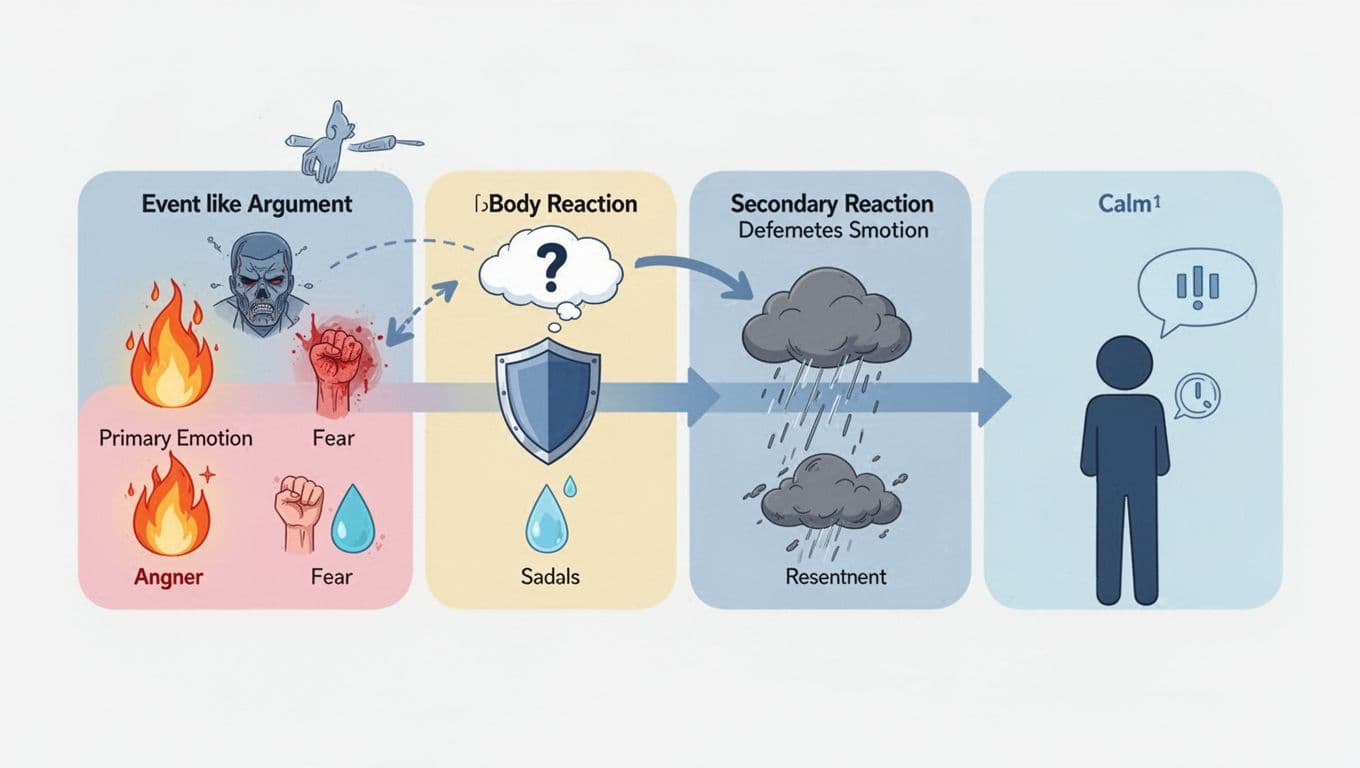
Primary emotions are your first, automatic responses. They arrive quickly, often in the body, like a rush of heat, a tight chest, or a drop in the stomach. They tend to be simple and direct: fear, sadness, anger, disgust, surprise, and joy often show up in lists of “basic” emotions (researchers like Paul Ekman helped popularise this idea).
Secondary reactions come after. They form when the mind adds meaning. Thoughts arrive, your inner commentary starts, and you predict what this “must mean”. That can create a second emotional layer, plus a behavioural urge.
Secondary reactions can include emotions, like shame, guilt, resentment, panic, or numbness. They also include behaviours, like shouting, withdrawing, people-pleasing, or doom-scrolling. Emotion-focused therapy often describes these secondary emotions as protective layers, because they can cover a more vulnerable feeling underneath.
A quick comparison helps make the timing clear:
| Part Of The Chain | What It Is | How It Feels | Common Result |
|---|---|---|---|
| Primary emotion | Fast, automatic signal | Body-first, simple | “Something’s happening” |
| Secondary reaction | Meaning and defence layer | Thought-heavy, sticky | “I must fix this now” |
| Behaviour | What you do next | Action, words, tone | Repair or rupture |
Here are a few mini chains you might recognise:
- A mate makes a joke at your expense, you feel embarrassment (primary), then shame and defensiveness (secondary), then you snap or mock them back (behaviour).
- Your boss sends “Can we talk?”, you feel fear (primary), then panic and worst-case thinking (secondary), then you can’t focus and keep checking your inbox (behaviour).
- Your child ignores you, you feel helplessness or sadness (primary), then anger and blame (secondary), then you raise your voice (behaviour).
Primary emotions are often universal and survival-based. Secondary reactions are more learned. Culture, family rules, past relationships, and old hurts shape them. That’s why two people can feel different “second waves” after the same event.
A Quick Self-Check, Can You Spot The Primary Emotion?
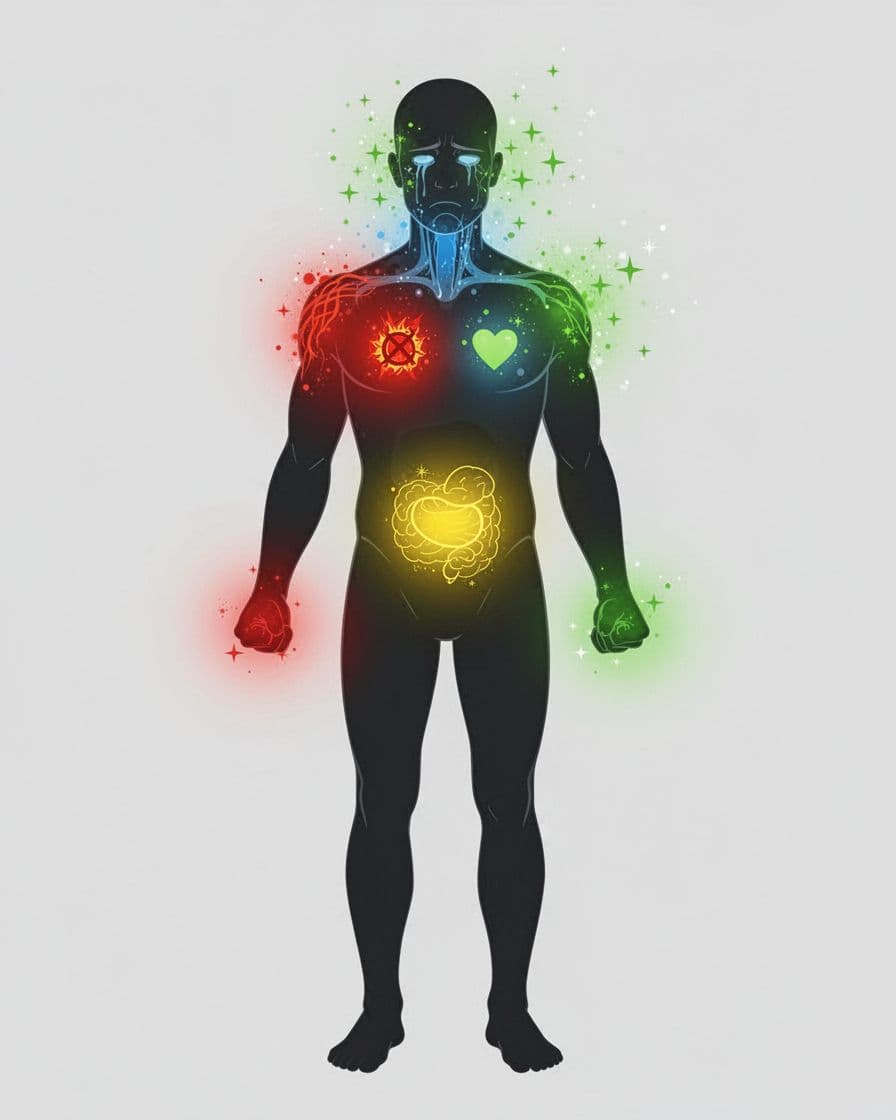
When you’re in it, everything feels blended. This is a fast way to separate “first feeling” from “second wave”.
Start with three prompts:
- What did I feel in the first two seconds?
- Where do I feel it in my body (throat, chest, stomach, face, hands)?
- What story did my mind add right after (about them, about me, about the future)?
If you need a simple word bank, try this:
Primary emotions often include: fear, sadness, anger, disgust, surprise, joy.
Secondary reactions often include: shame, guilt, panic, resentment, defensiveness, numbness.
You’re not trying to be perfect. You’re trying to be honest. Even getting it 60 percent right can change how you respond.
If you can name the first feeling, you get a split second of space. That space is where choice lives.
Why Secondary Reactions Can Feel More “Real” Than The First Feeling
Secondary reactions often last longer because thinking feeds them. Rumination keeps the body activated. Self-talk repeats the same message, and it starts to sound like truth.
Secondary reactions also protect you from pain. Anger can cover hurt. Joking can cover embarrassment. Blame can cover fear. Each one can help you avoid feeling exposed, at least for a moment.
They can also protect your image. If your identity is “I’m competent”, then feedback at work may trigger shame. The mind then moves into defence quickly, because that feels safer than “I might not be good enough”.
In relationships, the pattern is common. A partner forgets something important. The primary emotion might be sadness, or fear of not mattering. Then the secondary reaction arrives: anger, criticism, or the cold shoulder. The anger feels powerful, so it takes centre stage.
At work, a similar move happens. A manager questions your approach. The primary emotion might be fear. The secondary reaction could be resentment, which then shows up as sarcasm in the meeting. It feels “real” because it’s loud. Still, it isn’t always the first truth.
Why You Cannot Choose Your Feelings, But You Can Train Your Response
Your brain has an alarm system. It reacts quickly to threat, rejection, and uncertainty. That reaction often happens before slow thinking steps in. In plain terms, your body shouts first, then your mind writes the headline.
So you can’t reliably choose what you feel in the first beat. You can’t decide not to feel hurt when someone’s rude, or not to feel fear when something seems risky. You can pretend, but the signal still arrives.
The good news is this: feelings are signals, not orders. They bring information, not instructions. The choice point sits in what you focus on, what meaning you attach, and what you do next.
Trying to force emotions to stop can backfire. When people push feelings down, they often pop up sideways. You might get snappy, numb, or stuck scrolling. It’s like holding a beach ball under water. It takes effort, and it rarely stays down for long.
What you can control, even in a messy moment:
- Your attention (where you place it, and for how long)
- Your actions (what you do with your hands, feet, and voice)
- Your words (tone, timing, and content)
- Your interpretation (the story you repeat to yourself)
That’s not “be calm at all costs”. It’s “be deliberate when it matters”.
The Most Common Mix-Up, Confusing A Feeling With A Behaviour
A feeling is an inner experience. A behaviour is an outward choice. They often travel together, so people treat them as the same thing.
Here are a few pairs that help separate them:
- Anger is a feeling, shouting is a behaviour.
- Anxiety is a feeling, cancelling plans is a behaviour.
- Jealousy is a feeling, checking someone’s phone is a behaviour.
- Sadness is a feeling, isolating for days is a behaviour.
This matters because responsibility sits with behaviour. You didn’t choose the first feeling, but you’re still accountable for what you do next. That can sound harsh, yet it’s also hopeful, because it means you have options.
When “I Shouldn’t Feel This” Turns Into Shame
A common secondary reaction is judgement. You feel the primary emotion, then you criticise yourself for having it. That second layer often becomes shame or guilt.
For example, you feel anxious before a social event. Then you tell yourself, “This is pathetic.” Now you’re anxious and ashamed. After that, withdrawal makes perfect sense, because it avoids both feelings.
Try swapping judgement for validation plus direction. These lines keep the feeling real, while keeping behaviour intentional:
- “I feel hurt, I can pause before I reply.”
- “I’m anxious, so I’ll take one small step.”
- “I’m angry, so I’ll set a boundary without attacking.”
- “I’m sad, so I’ll ask for support instead of disappearing.”
Validation isn’t approval. It’s accuracy. It says, “This is what’s here”, and then you choose what to do with it.
A Simple Step-By-Step Method To Respond Better In Real Time
In heated moments, you won’t remember a long framework. You need something short, repeatable, and forgiving. Think of it like washing your hands, simple steps that reduce the mess.
Use this three-part process: Name it, pause, choose.
Here’s a worked example. You text a friend about plans. They reply, “K.” Your stomach drops. You feel hurt (primary). Then you think, “They don’t care”, and irritation rises (secondary). You’re about to send a sharp message. Instead, you run the steps.
Name It, Then Aim It (Label The Primary Emotion And Its Need)
Labelling works because it turns a vague storm into something you can hold. Keep it basic: “I feel ___.” Then add, “I need ___.”
Common pairings look like this:
- Anger often points to a need for boundaries, respect, or fairness.
- Fear often points to a need for safety, clarity, or reassurance.
- Sadness often points to a need for support, comfort, or time to grieve.
- Disgust often points to a need for distance, cleanliness, or values alignment.
- Surprise often points to a need for orientation, time to catch up.
- Joy often points to a need to share, connect, or savour.
In the “K” text example, you might say, “I feel hurt, I need reassurance or clarity.” That alone reduces the urge to attack.
Buy Yourself 90 Seconds (Pause Tools That Actually Work)

You don’t need to meditate for 20 minutes. You need a short pause that tells your body, “We’re safe enough to choose.”
Pick one or two tools you’ll actually use:
- Slow your exhale, because a longer out-breath often reduces intensity.
- Unclench your jaw, drop your shoulders, and loosen your hands.
- Sip water slowly, it creates a natural reset.
- Step into another room, even for 30 seconds.
- Name five things you can see, it shifts attention out of the spiral.
- Write a draft response, then wait before sending.
Choose something discreet if you’re at work or on public transport. The goal is space, not perfection.
Choose A Response You Can Live With Tomorrow
A good response isn’t always calm. Sometimes it’s firm. The key is that it’s respectful and aligned with your values.
Try sentence starters like these:
- “I’m feeling a bit wound up, can we pause for 10 minutes?”
- “I need to think before I answer.”
- “Can you say a bit more about what you mean?”
- “I don’t want to talk like this, let’s reset.”
- “I’m sorry for my tone, let me try again.”
- “That doesn’t work for me, I can do X instead.”
Back to the “K” text. A response you can live with might be: “Hey, your reply felt a bit short. Are we still on for tomorrow?” It’s direct, not accusatory. It checks meaning before building a story.
Putting It Into Practice, Everyday Scenarios That Trigger Secondary Reactions

Practice works best with real life, not theory. The aim is to notice the chain, then interrupt it earlier next time.
Arguments And Text Messages, Hurt First, Anger Second
A partner sends a short reply, or they sound distant. The primary emotion is often hurt, or fear of rejection. Then the secondary reaction arrives: anger, blame, or a need to “win”.
The behaviour might be snapping, sarcasm, or the silent treatment. It can feel justified, because the anger is loud. Still, the primary hurt needs attention.
A better next step is to check meaning and name impact. Try: “I read that as a bit cold, are you upset with me?” Or: “I’m feeling a bit tender today, can you reassure me?” It’s brave, because it admits the first feeling.
Work Feedback, Fear Of Failure Turning Into Defensiveness
Feedback can trigger fear quickly. For some people, it triggers shame, even when the message is fair. Then the secondary reaction arrives: defensiveness, over-explaining, or quiet resentment.
The behaviour often shows up as arguing in the meeting, or sending a long email to prove you’re right. That may protect your pride for a minute, but it can harm trust.
Instead, pause and narrow the task. Ask for one example: “Can you point to a specific part that needs work?” Then agree a next step: “Okay, I’ll revise that section by Thursday.” Later, give yourself a minute to settle, because the body might still feel on edge.
Social Media And News, Anxiety Turning Into Doom-Scrolling
An alarming headline hits. The primary emotion is fear. Then the secondary reaction grows, anxiety spirals, and the mind searches for certainty.
Doom-scrolling becomes the behaviour. It feels like “staying informed”, but it often keeps the alarm system switched on, especially late at night.
A different response can be small and practical. Set a time limit, then switch to a grounding task, like washing up or a short walk. If action helps, pick one tiny step, like donating, writing to your MP, or helping locally. It won’t fix everything, but it stops the spiral from driving the evening.
Conclusion
You can’t choose your primary emotion, because it’s an automatic signal. Still, you can learn to spot it, soften the secondary reaction, and choose a behaviour you respect. That’s where your real influence sits.
Practise once a day in a low-stakes moment: name the first feeling, pause for 90 seconds, then pick a response aligned with your values. If your reactions feel unsafe, overwhelming, or tied to trauma, getting professional support can help you build steadier tools. With time, choice starts to show up earlier.
FAQ
What Is A Primary Emotion In Simple Terms?
A primary emotion is the first feeling that shows up after an event. It tends to arrive fast and feels body-based, like a jolt of fear or a flush of anger. You usually notice it before you’ve fully thought it through.
What Counts As A Secondary Emotion Or Secondary Reaction?
Secondary emotions build after interpretation, self-talk, and memory. Shame, guilt, resentment, and defensiveness are common examples. Secondary reactions also include behaviours, like withdrawing, arguing, or scrolling.
Is Anger Always A Secondary Emotion?
No, anger can be primary. Still, anger often acts as a protective cover for hurt, fear, or embarrassment. Checking what came first can help you respond with more honesty.
How Do I Find The First Feeling When Everything Happens So Fast?
Start by asking what you felt in the first two seconds. Then look for the body cue, like tightness in the chest or heat in the face. Finally, notice the first sentence your mind added, because that often marks the shift into secondary reaction.
Does Naming An Emotion Really Help?
Yes, for many people it reduces intensity and improves control. A 2022 research comparison also suggested basic emotion words often feel more concrete than secondary ones, which can be more abstract and thought-driven. In everyday terms, simple labels can keep you anchored.
What If My Emotion Feels Too Big To Pause?
Go smaller. Take one slow exhale, relax your jaw, and buy 10 seconds first. If the situation feels unsafe, step away and get support from someone you trust.
What’s The Difference Between Emotional Control And Emotional Suppression?
Control is choosing a response while letting the feeling exist. Suppression is trying to force the feeling to disappear. Suppression often backfires later as irritability, numbness, or sudden outbursts.
When Should I Consider Therapy For Strong Reactions?
Consider it if reactions harm relationships, work, sleep, or safety. It’s also worth seeking help if certain triggers link to past trauma or panic. Therapy can help you spot primary emotions sooner and reduce the secondary spirals that follow.
Leave a Reply