

In a study of 126 Year 7 pupils, mixed maths practice produced scores of 80%, compared with 64% for blocked practice after one day. That result feels backwards when repeated drills often seem smoother and faster.
Interleaving mixes related skills or problem types across your study sessions, while the blocked approach repeats one skill at a time. It can feel harder, yet that effort often supports more effective learning when you need to recall a skill under real pressure.
Key takeaways
- Interleaving mixes related skills, while blocked practice repeats one skill before moving on.
- Repetition can improve performance during a session, but mixed practice usually supports later recall.
- Switching between similar tasks makes you choose the right method instead of copying the last one.
- Use short repetition when a skill is brand new or the learner feels overloaded.
- Move towards mixed practice once the basic movement, concept, or procedure is understood.
- Combine interleaving with distributed practice by spacing mixed-skill reviews across several days. This changes review timing, while interleaving changes task order.
- Expect more errors during interleaving, then judge progress with delayed tests rather than session comfort.
- Keep tasks related, because random switching can drain attention without improving learning.
Interleaved Practice Vs Blocked Practice
Blocking groups one task together. A maths pupil might complete 12 fraction additions, then 12 fraction multiplications. A tennis player might practise only forehands for 20 minutes. A violinist might repeat one bowing pattern until it feels automatic.
Interleaving changes the order. The pupil alternates addition, multiplication, comparison, and word problems. The player rotates forehands, backhands, serves, and returns. The violinist shifts between scales, bow strokes, rhythm work, and a short passage.
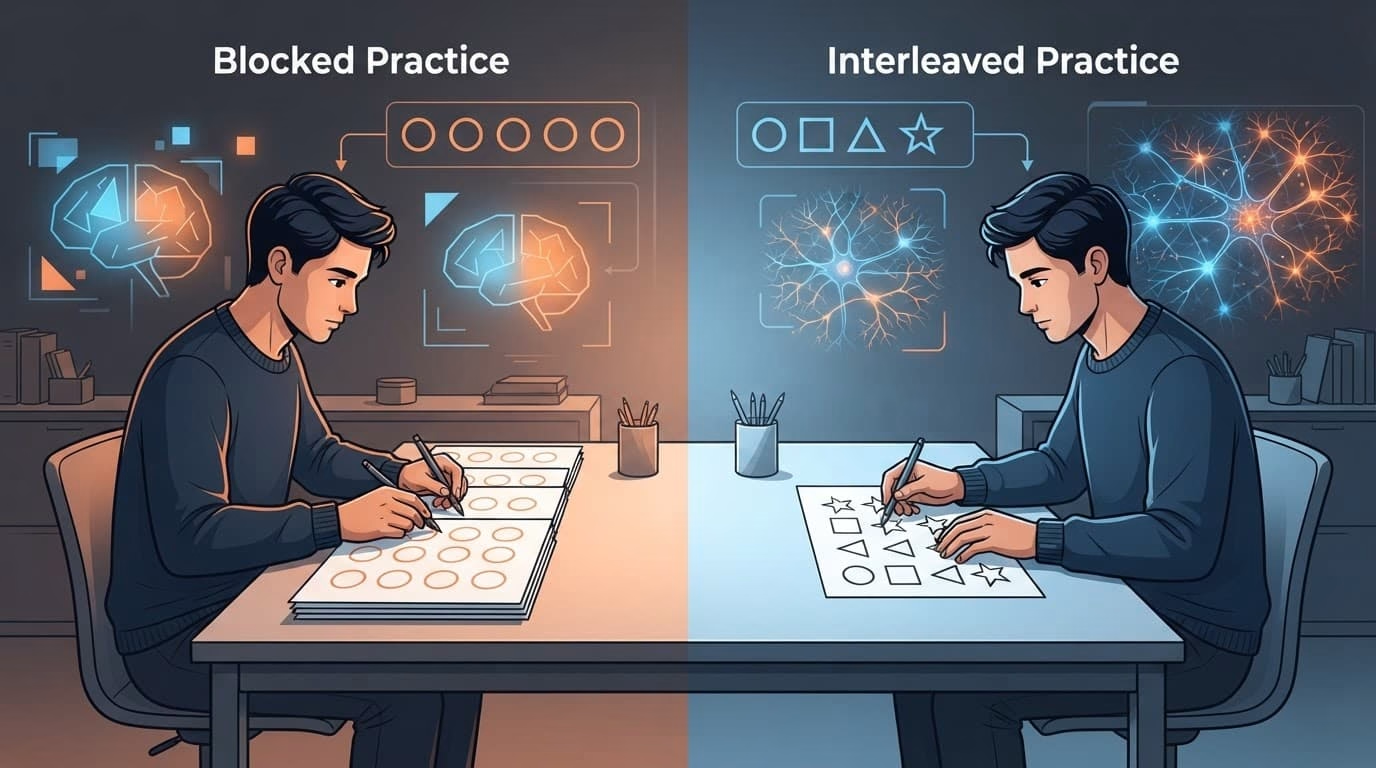
Both methods have a place. However, blocked practice and interleaved practice organise task order differently, creating different learning outcomes. Blocking helps a learner grasp a new sequence. Interleaving supports retrieval practice later, when they must recognise a situation and select the right response.
That distinction matters in exams, performances, matches, clinical work, and most jobs. Real situations rarely announce which method you should use first.
Why Mixed Practice Builds Durable Learning
Interleaved practice makes the brain retrieve, compare, and decide. Cognitive science helps explain why these cognitive processes support durable learning. Repeating one action can build fluency, but it may remove those decisions. That is why a smooth practice session doesn’t always predict a strong test result.
Retrieval Breaks The Pattern Of Copying
When problem types alternate, you cannot rely on the answer method from the previous question. You must recall what you know, identify the task, and restart the procedure.
For example, a learner working on algebra may see factorising, expanding brackets, and solving equations in one set. Each new question requires a fresh choice. That added retrieval strengthens access to knowledge and supports long-term retention.
This connects with active recall for stronger memory, because both methods involve retrieval practice, bringing information to mind without relying on an answer directly in front of you.
Discriminative Contrast Improves Choice
Related skills often look similar at first. Interleaving creates discriminative contrast, meaning you notice the clues that separate one category from another.
A physics student may need to distinguish perceptual categories, meaning groups of similar-looking problems, before choosing a conservation law, Newton’s second law, or a kinematics equation. Doing ten similar questions in a row can hide differences between these perceptual categories. A mixed set forces attention onto the features that matter.
The useful difficulty in interleaving is choosing a method, not fighting a confusing or poorly explained task.
This is why interleaving supports problem-solving skills as well as memory. It teaches selection, not only execution, which matters in complex learning.
Why Interleaved Practice Feels Harder
Interleaved practice often feels harder because each new task demands fresh retrieval. That effort can make progress feel less visible.
Fluency Can Mislead Learners
Blocked practice gives quick signs of progress. Your tenth repetition often feels better than your first because the movement or method remains active in short-term memory. That ease feels reassuring, but it can create a false sense of mastery.
A learner may complete several practice sessions accurately, then struggle when the same questions appear in a mixed order two days later. Earlier success came partly from knowing what type of task was next.
Interleaving removes that clue. Errors rise during practice, confidence can drop, and learners may assume the method is failing. Yet later performance can reveal stronger retention.
This mismatch is one of several metacognitive illusions. Metacognitive strategies for learning help learners judge practice strategies by delayed evidence, rather than by ease during one session.
Feedback Should Track Later Performance
Do not ask only, “How well did this go today?” Ask, “Can I do this tomorrow without hints?” That question shifts attention from comfort to retention.
Teachers and coaches can make this visible with distributed practice, leaving at least one day between reviews. At the next lesson, give a five-question delayed quiz as a mixed check, and use criterial tests to check whether the intended skill has been met. Record accuracy, common errors, and time taken. Over several sessions, the pattern becomes clearer.
What Research Shows In Maths And Physics
The clearest classroom evidence comes from cognitive science research in subjects where learners must choose between similar methods. Maths and physics both involve discriminative contrast, as learners classify similar-looking problems into perceptual categories before selecting a procedure.
Classroom Maths Results Favour Mixing
Rohrer, Dedrick, and Burgess studied 126 seventh-grade pupils over three months. During their assigned study sessions, pupils completed the same amount of practice. One group received interleaved practice, and the other blocked practice.
The mixed-practice group outperformed the comparison group on unannounced tests after one day and 30 days. The reported effect was larger at 30 days, with Cohen’s d of 0.79, suggesting stronger long-term retention. Another study involving 54 Year 7 classes found 61% for mixed sets and 38% for blocked sets on a one-month surprise test.
These results don’t mean every assignment sheet should be scrambled. The experimental design compared specific practice arrangements. It suggests mixed practice may improve delayed recall when learners identify the right procedure.
Physics Homework Tests Transfer
Samani and Pan’s 2021 undergraduate physics study used homework sets with either blocked or interleaved problem types. The students later sat two surprise criterial tests containing unfamiliar, harder questions.
Students who had received interleaved homework performed better on those criterial tests. The reported median improvement was about 125% on a delayed assessment, suggesting meaningful performance gains.

The key point is transfer. Homework should build problem-solving skills for questions that look different, not only help students finish the next page.
How To Convert A Blocked Session Into Mixed Practice
You do not need a new curriculum to begin. Start by reordering familiar practice sessions to create interleaved practice, while keeping the total workload sensible.
Learners should first know what each task involves. A 30-minute maths revision session could use three groups of related questions. Begin with two linear equations, then two percentage changes, then two ratio questions. Repeat that cycle with new examples. The same approach works for language grammar, coding exercises, sports drills, and workplace procedures.
| Practice Stage | Blocked practice | Mixed Version |
|---|---|---|
| Maths | Ten examples of one method | Two examples each of five related methods |
| Music | Fifteen minutes on one scale | Short rotations across scales, rhythm, and repertoire |
| Sport | Twenty serves in one position | Serves mixed with returns and movement patterns |
| Workplace Training | One procedure repeated | Similar cases requiring different procedures |
Keep early rounds simple. Then add more realistic variations once learners can identify the basic categories.
Try spaced practice by revisiting a mixed session today and again in two days, rather than completing one exhausting session. This distributed practice supports effective learning through short, repeatable reviews. A simple spaced revision plan can help build distributed practice into a regular routine.
Using Interleaving In Music, Sport And Work
The best practice schedule depends on the skill. Still, interleaved practice follows a steady rule: rotate tasks that demand a meaningful choice.
A Better Home Practice Sheet For Musicians
For music students, teachers can shape home practice with a short rotation rather than a single long drill. A simple assignment sheet can set out five minutes on a scale, five on bow control, five on a difficult phrase from a repertoire piece, five on rhythm clapping, then a return to the phrase.
On the next home practice rotation, change the order. Across several days, repeat the plan as distributed practice. The pupil must retrieve the technical focus rather than settle into one repeated motion. They can also alternate passages in different keys or articulations.

Avoid switching every few seconds. Musical practice still needs enough time to hear, correct, and repeat a phrase with care.
Sports And Workplace Skills Need Realistic Variety
In sport, contextual interference describes the same broad effect. A goalkeeper who faces varied shot types must read cues and select responses. A player repeating one predictable shot may look sharp in training but struggle with a changing match.
Workplace training follows a similar pattern. A customer-service adviser can practise cases involving billing, cancellations, and complaints in mixed order. This develops problem-solving skills as they select the right response. A nurse can rehearse related clinical scenarios that require different checks. The mix should mirror decisions people make on the job.
When Blocked Practice Is The Better Starting Point
Blocked practice still has a role. Beginners often need a calm introduction before they can benefit from variation.
Use a short focused phase when complex learning leaves a learner unable to perform the core action. A child learning basic times tables may need several examples of one operation. A pianist learning unfamiliar fingerings may need slow repeats. A trainee using safety equipment needs clear, stable instructions first.
Use A Hybrid Practice Schedule
Start by demonstrating the action, then allow brief repetition to form a workable pattern. Add one related task when the learner can perform the first with some consistency. Increase variation gradually through interleaved practice, using distributed practice across several sessions and leaving time for feedback.
For example, a beginner swimmer could spend ten minutes on one breathing pattern. During the second half, they could alternate breathing work with body position and easy turns. As confidence grows, teachers can adjust their practice strategies and mix those skills within full lengths.
High cognitive demand means the learner is handling too much mental work at once. If learners can’t notice cues, retrieve steps, or correct performance, reduce the number of items. These cognitive processes need room to develop, and Understanding cognitive load helps explain why overloaded practice can turn productive effort into frustration.
Build A Practical Interleaving Plan
A good practice schedule keeps interleaved practice small enough to repeat across study sessions. Choose skills that are related but distinguishable, then set a clear check for later performance.
- Choose three to five skills that learners commonly confuse, such as percentage change, ratios, and fractions.
- Give each skill a brief blocked introduction if it’s new, with clear feedback and worked examples.
- Create a mixed set where no task type appears more than twice in a row.
- Revisit the same group after a day or two, using distributed practice, then add a short no-notes test for retrieval practice. Treat the result as evidence of later capability, not a judgement of the learner’s worth.
- Use the evidence to adjust the ratio and refine your practice strategies, rather than trusting how easy the session felt.
A learner preparing for GCSE maths might use 12 questions across four topics. A sales trainer might use six short customer scenarios across three common objections. A guitarist may use a rotation of chord changes, rhythm patterns, and song sections during home practice.
Keep unrelated distractions out of the plan. Interleaving related tasks is purposeful. Constant notifications and random task changes drain attention instead of building skill.
Common Mistakes That Weaken Mixed Practice
The first mistake is mixing tasks before learners know what they are. Interleaved practice works better after brief instruction and a few guided attempts, so learners can recognise each method before comparing them. Raise the challenge only once that foundation is secure.
The second is grouping topics that have little in common. A French vocabulary task, a chemistry calculation, and a sprint drill do not share useful perceptual categories. Switching among them creates fatigue rather than discriminative contrast. Choose related tasks with a meaningful distinction to notice, or you are creating ordinary context switching instead of productive variation.
Another problem is testing immediately after practice. Learners may perform well during identical runs because the method remains fresh, not because it is durable. Add a delay, even overnight, before comparing results, using distributed practice to test whether recall survives.
Finally, don’t equate errors with failure, since fear of mistakes can make learners avoid contrasts that expose missing distinctions or forgotten steps. Treat each useful error as feedback: correct it, revisit it later, and match these instructional approaches to learner readiness. Watch whether the learner can recover without help.
Conclusion
Fast-looking practice and long-term retention aren’t always the same thing. Interleaved practice feels harder during the session, but performance gains often appear later rather than as immediate fluency.
Use blocked practice to establish the basics. Then mix related skills, revisit them through distributed practice after a delay, and judge progress by the learning outcomes you can demonstrate unaided when the answer’s no longer obvious.
FAQ
What Is Interleaved Practice?
Mixed practice combines related topics or skills within one session. A learner might alternate algebra, ratio, and percentage questions instead of completing one topic at a time. It works best when each task requires a different choice.
Is Interleaving Better Than Blocked Practice?
It often supports delayed recall and transfer to new situations. Blocked work can help beginners build initial understanding or movement patterns. Most learners benefit from using both approaches in sequence.
Why Does Interleaving Feel Less Effective?
The method interrupts the feeling of repetition-based fluency. You make more decisions and may make more errors, so progress feels slower. Later tests may show that the harder session produced stronger retention.
How Long Should An Interleaved Practice Session Be?
There is no fixed ideal length. A 20 to 40-minute session works well for many learners when it includes several related skills and useful feedback. Short, repeated sessions are usually more helpful than one exhausting session.
Can Beginners Use Interleaved Practice?
Yes, but they need a gentler version. Teach each basic skill first, then mix two familiar tasks. Add more variation as their confidence and accuracy improve.
How Should Teachers Mix Homework Problems?
Place related problem types in a varied order and avoid long runs of identical questions. Give enough examples of each type, then include mixed questions requiring method selection. Review errors at the next lesson.
Does Interleaving Work For Music Practice?
Yes, especially when musicians must recall different techniques during performances. Rotate scales, rhythms, articulation, technical drills, and short repertoire sections. Keep a brief blocked phase for brand-new passages or unfamiliar fingering.
What Is The Difference Between Interleaving And Spaced Practice?
Interleaving changes the order of tasks within a session. Spaced practice spreads review across time. Combining them works well because you choose the right skill and retrieve it after some forgetting.
Leave a Reply