
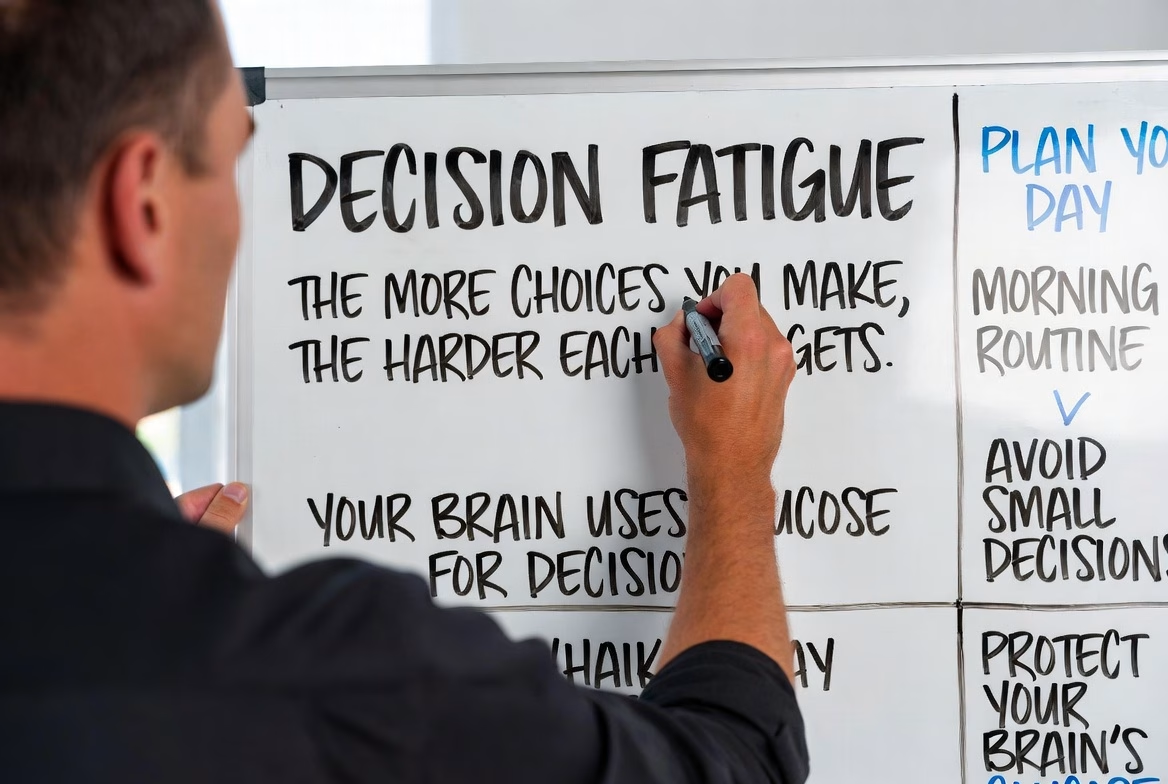
Imagine you make over 35,000 choices every single day. From what to wear to which email to answer first, your brain is constantly on call. This mental load has a name: decision fatigue. It is the exhausting feeling that creeps in after a long day of making choices, big and small. It can leave you feeling drained, irritable, and prone to making poor decisions. The good news is you can fight back. A structured morning plan can shield your brain, saving your mental energy for the decisions that truly matter.
Key Takeaways
- Decision fatigue is the mental exhaustion that comes from making too many choices, which can lead to poor judgement and willpower depletion.
- Your willpower and decision-making ability are finite resources that deplete throughout the day, much like a muscle that gets tired.
- A consistent morning routine automates trivial decisions, freeing up cognitive bandwidth for more important tasks later.
- Preparing the night before, from clothes to meals, is a powerful way to reduce decision load at the start of your day.
- Limiting your choices in areas like wardrobe and breakfast can prevent unnecessary mental strain.
- A short period of focused work on your most important task in the morning leverages your peak mental clarity.
- Batching similar small decisions, like checking emails at set times, prevents constant context-switching.
- Protecting your morning from digital distractions helps you start the day with intention, not reaction.
What Is Decision Fatigue
Decision fatigue describes the deteriorating quality of decisions after a long session of making choices. Think of your brain’s decision-making power like a battery. Every choice, no matter how small, uses a little bit of that charge. By the afternoon or evening, your battery is running low. This is why you might snap at a colleague over a minor issue or impulsively buy something online you do not need. Your brain, tired from a day of decisions, looks for the easiest path, which is often not the best one. Understanding this concept is the first step to managing your mental energy more effectively.
Your Brain’s Willpower Is Limited
Science shows that willpower and focused decision-making draw from the same limited pool of mental resources. Researchers often compare it to a muscle that gets fatigued with use. Making repeated choices, especially about things you should or should not do, depletes this resource. For example, resisting a biscuit, choosing a work task, and deciding how to phrase a difficult email all tap into the same reserve. Once it is low, your ability to self-regulate and make thoughtful choices plummets. This is not a personal failing. It is a biological constraint. Recognising this limit allows you to work with your brain, not against it.
Why Mornings Hold The Key
Your mental energy is typically at its highest after a night’s rest and before the day’s demands chip away at it. The morning sets the tone for everything that follows. If you start your day by scrolling through social media, answering frantic emails, and debating what to wear, you burn through your decision-making battery before you have even begun your real work. Conversely, a calm, pre-planned morning conserves that precious cognitive fuel. It allows you to allocate your best thinking to your most important projects, not to trivial matters. Protecting your morning is about protecting your potential for the entire day.
The Night Before Prepares The Morning
Your morning routine truly begins the evening before. This is a simple yet transformative practice. Take ten minutes before bed to make decisions for the next day. Lay out your clothes. Pack your lunch or prepare breakfast ingredients. Write down your top three priorities for the next day. This act of preparation does more than save time. It transfers dozens of potential morning decisions from your future, tired self to your current, more rested self. You wake up to a plan, not a blank slate full of questions. This creates immediate momentum and a sense of control from the moment you open your eyes.
Simplify Your Wardrobe Choices
What you wear is one of the first decisions of the day. You can eliminate it entirely with a bit of strategy. Many successful people adopt a version of a “uniform” to minimise this daily choice. This does not mean wearing the same outfit every day. It means creating a simplified, cohesive wardrobe. Choose a colour palette that mixes and matches easily. Keep your work clothes separate from your casual clothes. Some people even dedicate specific outfits to specific weekdays. The goal is to look at your wardrobe and see clear, easy combinations, not a overwhelming array of possibilities. This one change can save a surprising amount of mental energy.
Automate Your Breakfast Routine
The “what’s for breakfast” dilemma is another common energy drain. The solution is to make it a non-decision. Choose one or two healthy, simple breakfast options you enjoy and stick to them on weekdays. It could be porridge with berries, yoghurt with nuts, or a smoothie. Prepare what you can the night before. The point is to remove the need to ponder, debate, or cook something elaborate when your willpower is fresh. You are fuelling your body reliably without taxing your brain. This consistency also helps regulate your energy levels, preventing mid-morning slumps that can derail your focus.
Guard The First Hour For Deep Work
Your first hour of focused work is often your most productive. After your simplified morning routine, immediately begin your most important task. This is the task that will have the biggest impact on your goals. Do not check email. Do not attend a routine meeting. Protect this time fiercely. Because your decision-making energy is at its peak, you will work with greater clarity and efficiency. Completing a significant piece of work early creates a powerful sense of accomplishment. This success fuels positivity and momentum for the rest of your day, making subsequent decisions feel easier to manage.
Batch Small Decisions Later
Not every decision can be eliminated, but many can be grouped together. This practice is called batching. Instead of checking emails or messages constantly, which forces micro-decisions all day long, schedule two or three specific times to handle them. Apply the same logic to administrative tasks, phone calls, or even planning your meals for the week. By batching, you contain the mental cost of switching contexts. You make many similar decisions in one focused session, then you can move on. This prevents the constant, draining ping-pong between different types of thinking that characterises a fragmented day.
Create A Digital Quiet Zone
Starting your day by immediately reaching for your phone is a recipe for decision fatigue. You are inviting the world’s demands, news, and other people’s priorities into your mind before you have had a chance to set your own. Try to keep the first 30 to 60 minutes of your day screen-free, or at least free of reactive communication like email and social media. Use this time for your routine, some quiet reflection, or reading a book. This creates a buffer between sleep and the demands of the day. It allows you to start from a place of calm intention, rather than anxious reaction. You decide how your day begins, not your notifications.
Conclusion
Decision fatigue is a real drain on your mental resources, but it is not an inevitable part of life. By understanding that your willpower is limited, you can stop fighting your biology and start designing your days around it. A simple, consistent morning plan acts as a shield for your brain. It automates the trivial so you can excel at the essential. The goal is not to eliminate all choice, but to spend your decision-making currency wisely on things that truly move you forward. Start tonight. Spend ten minutes preparing for tomorrow. That single, small decision is the first step to reclaiming your focus and energy every day.
FAQ
What are the main signs of decision fatigue?
Common signs include feeling mentally drained by the afternoon, increased irritability over minor issues, procrastination on important choices, and a tendency to make impulsive or poor decisions later in the day. You might also feel completely unable to decide on something simple, like what to have for dinner.
Is decision fatigue the same as being tired?
Not exactly. While general tiredness can make everything harder, decision fatigue is specifically the exhaustion of your brain’s executive function. You might feel physically okay but mentally incapable of weighing options or exercising self-control, which is a hallmark of this type of fatigue.
How long does it take for a morning routine to help?
You may notice a difference in your daily stress levels within the first week. However, for the routine to become an automatic habit that effectively conserves mental energy, most people need to practice it consistently for about three to four weeks.
Do I need to wake up very early for this to work?
No, the principle works regardless of your wake-up time. The key is dedicating the first part of your waking hours to a calm, pre-planned sequence. Whether you start at 5am or 9am, protecting that initial period from chaos and choice is what matters.
What if my job requires constant decision-making?
This makes a morning routine even more critical. By automating your personal start to the day, you preserve a larger portion of your decision-making energy for your professional demands. Batching similar work tasks can also help manage the load within your job itself.
Can reducing choices make life boring?
It might seem that way, but the opposite is often true. By removing the mental clutter of trivial daily choices, you free up space and energy for the choices you genuinely care about. You have more capacity for creativity, hobbies, and meaningful decisions rather than feeling bogged down by mundane details.
Should I plan my entire day in the morning?
It is helpful to have a clear plan, but avoid an overly rigid, minute-by-minute schedule. Focus on identifying your top one to three priorities. This provides direction without the stress of managing a complex timetable, leaving room for the unexpected while still ensuring progress.
What is the single most effective habit to start with?
Preparing the night before. Taking just five to ten minutes to lay out clothes, pack a bag, and note your top priority for the next day has an immediate and powerful impact. It creates instant calm and control the moment you wake up, setting a positive tone.
Leave a Reply