

Two people can share the same weight and clothes size, yet have very different health risks, because fat and muscle don’t sit in the same places. That’s why the bathroom scale often tells the wrong story.
A DEXA scan (also written DXA) can show fat, lean mass, and bone in one short appointment. Those numbers can help you spot risks that affect healthspan, like frailty, falls, and poor metabolic health, while there’s still time to act.
This is for busy adults, midlife exercisers, older adults, and anyone losing weight who wants to keep strength. This article is information only, not personal medical advice.
Key Takeaways
- Muscle is a practical reserve for ageing, it supports balance, recovery, and independence.
- DEXA measures lean mass, fat mass, bone density, and often an estimate of visceral fat.
- Scales and BMI can mislead because they can’t show where fat sits or how much muscle you carry.
- Lean mass on DEXA isn’t pure muscle, but it’s still useful for tracking change over time.
- The most helpful trend is usually limb lean mass plus visceral fat (if your report includes it).
- If lean mass looks low, strength training and enough protein can often improve the next scan.
- To compare results fairly, re-scan at the same clinic under similar conditions each time.
- Many people recheck every 3 to 6 months during a focused goal phase, or every 6 to 12 months for maintenance and ageing, depending on needs.
What A DEXA Body Composition Scan Actually Tells You
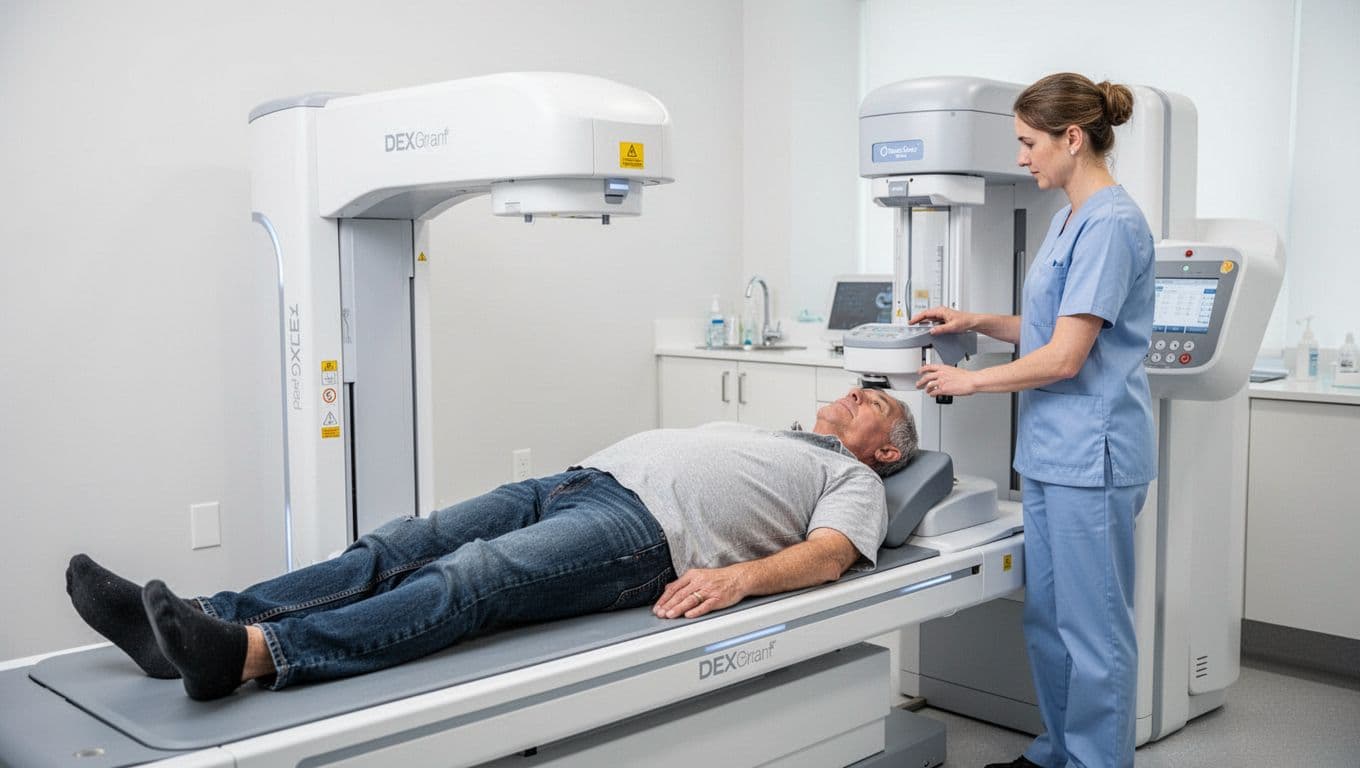
DEXA stands for dual-energy X-ray absorptiometry. In plain English, it uses a low-dose X-ray to separate your body into bone, fat tissue, and lean tissue. You lie still on a table for a few minutes, usually fully clothed, while an arm passes over you.
A body composition DEXA report often includes:
- Total body fat percentage and total fat mass
- Lean mass (your non-fat, non-bone tissue)
- Regional lean mass, such as arms, legs, and trunk
- Bone mineral content and sometimes bone density measures
- Visceral fat estimate (not every clinic includes this)
Lean mass is the metric that causes the most confusion. It’s not 100 percent muscle. Lean mass also includes water, organs, and connective tissue. Even so, it’s still one of the best ways to track whether a fat loss plan is stripping muscle, or whether training is building useful tissue in the limbs.
If you only remember one idea, make it this: DEXA gives you a map, not just a single number. A scale is like weighing a suitcase. DEXA is like opening it and seeing what’s inside.
DEXA Vs Scales, BMI, And Smart Scales: Why Results Can Look Confusing
BMI is a ratio of weight to height. It can’t tell the difference between muscle and fat. It also can’t show fat distribution. That matters because fat around the waist tends to track more closely with metabolic risk than fat stored elsewhere.
Bathroom scales only measure total weight. They don’t know if a kilogram change came from fat, muscle, water, or food still being digested. Smart scales (bioelectrical impedance) try to estimate body fat by sending a tiny current through the body. However, hydration, salt intake, alcohol, a big meal, and even a hard workout can shift the reading.
Here’s a simple example. Two people both weigh 80 kg. One lifts weights and has more muscle in the legs and back. The other has less muscle but more visceral fat around the organs. The scale sees them as identical. DEXA often won’t.
DEXA is often called a gold standard for body composition in clinical and sports settings. Still, it isn’t magic. It’s a very good measurement tool, and like any tool, it works best when you use it consistently.
How Accurate Is DEXA For Muscle And Fat, And What Can Throw It Off?
When clinics follow good practice, DEXA can be very precise, with typical error around 1 to 2 percent for body fat in general adults. In older adults, comparisons with more complex “multi-compartment” methods suggest body fat percentage error can be larger, sometimes around plus or minus 5 percent. That doesn’t mean the scan is useless, it means you should treat single readings with care.
Several things can nudge results:
- Different machines or scan modes can produce slightly different outputs
- Positioning matters, small shifts change regional values
- Movement blurs the data
- Hydration and food change soft tissue readings
- Calibration affects everything, especially if a clinic is lax
The best habit is simple. Use the same clinic, scan at a similar time of day, and keep conditions similar (for example, avoid a heavy meal right before). Then focus on the direction of travel across two or three scans, not the drama of one number.
A DEXA scan is most helpful as a trend tool. Consistency beats perfection.
Why Muscle Mass Is A Longevity Metric, Not A Vanity Metric
It’s easy to treat muscle as an aesthetic goal. In reality, muscle is a working organ system that supports day-to-day life. It helps you climb stairs, catch yourself if you trip, carry shopping, and get up from the floor. Those aren’t gym tasks, they’re independence tasks.
Muscle also acts like a “metabolic sink”. After meals, muscle helps clear glucose from the blood. More muscle and better muscle function can improve insulin sensitivity. That doesn’t guarantee protection from disease, but it can tilt the odds in your favour when combined with sleep, food quality, and activity.
Another reason muscle matters is illness and injury. When you get flu, have surgery, or face a period of low appetite, the body often pulls from lean tissue. People with more muscle and strength can have a bigger buffer. Think of it like savings in a bank account. You don’t build savings to show them off, you build them because life happens.
Clinicians sometimes use the term sarcopenia for low muscle mass and low muscle function, often with ageing. It’s linked with frailty and falls, and it can start earlier than most people expect. The slide can be slow for years, then speed up after illness, stress, or long periods of inactivity.
DEXA helps because it can show changes in lean mass that your weight won’t reveal. A stable weight can hide quiet muscle loss, especially if fat mass rises at the same time.
Strength And Muscle Loss With Age: What The Research Suggests
For longevity, strength often tells the story even better than size. Grip strength and chair stand tests are simple, cheap measures of function. They’re also linked to health outcomes in large studies.
Recent findings in older women suggest that higher grip strength is associated with a lower risk of death from any cause. One 2026 study following women over 60 reported that the strongest group had a 33 percent lower risk of death compared with the weakest group, after adjusting for many health and lifestyle factors. Another large European study in adults aged 50 plus reported lower mortality risk in those with stronger grip, often in the range of 30 to 40 percent, depending on the analysis and groups compared. These are associations, not proof of cause, but the signal is consistent.
Chair stand speed matters too because it reflects leg strength and power, which help prevent falls. Meanwhile, grip strength can act as a general snapshot of overall strength and health status.
DEXA and strength tests work well together. DEXA shows what you have. Strength tests show what you can do with it. If DEXA shows low limb lean mass and your chair stands are slow, that’s a clearer prompt than either measure alone.
The Muscle To Visceral Fat Balance: A Useful Way To Think About Risk
Not all fat behaves the same. Subcutaneous fat is the softer fat under the skin. Visceral fat sits deeper, packed around organs in the abdomen. It’s more strongly linked with higher cardiometabolic risk than “pinchable” fat, even when total body fat isn’t extreme.
Some DEXA reports include a visceral fat estimate. Treat it as an estimate, not a diagnosis. Even so, it can be a helpful north star. If visceral fat trends down while limb lean mass stays steady or rises, you’re usually moving in a useful direction for healthspan.
People sometimes chase weight loss like it’s the only scoreboard. That can backfire. Aggressive dieting can reduce visceral fat, but it can also pull down lean mass. Over time, that may increase frailty risk, especially in older adults.
A better mental model is a two-part aim:
- Protect or build muscle and strength
- Reduce visceral fat where possible
That framing changes your plan. You lift weights, you eat enough protein, and you don’t slash calories so hard that training quality collapses.
How To Use DEXA Results To Guide A Simple, Safe Plan
A scan only helps if it changes what you do on Monday. The goal isn’t to collect stats, it’s to make decisions with less guesswork.
Start by picking one primary goal for the next 8 to 12 weeks. For example, “lose fat while keeping lean mass” or “increase limb lean mass” or “improve left to right balance after injury”. Next, choose two or three behaviours that match that goal. Then recheck using the same method.
Avoid the common trap of trying to improve every metric at once. If you push hard for fat loss and muscle gain at the same time, progress can be slow. Many people do best with phases, a steady fat loss phase, then a lean gain or strength phase, then maintenance.
Also, know when you need support. Speak to a clinician if you have rapid unplanned weight loss, signs of an eating disorder, known osteoporosis risk, severe fatigue, or you suspect sarcopenia. A scan is not a substitute for medical assessment.
What To Look For On Your Report (And What Matters Most Over Time)
Most people get better results by focusing on a few lines, not the whole report.
Prioritise these, if available:
- Appendicular lean mass, or limb lean mass, because arms and legs are where useful muscle shows up
- Total lean mass trend, as a broad “are we keeping tissue?” check
- Body fat percentage trend, because it moves differently from weight
- Visceral fat estimate trend, if your report includes it
- Left to right differences, because big gaps can hint at underuse or injury
A single scan is a snapshot. Two scans show direction. Three scans show pattern.
For re-scan timing, a sensible range is:
- Fat loss phase: about every 3 to 6 months
- Muscle gain or strength phase: about every 4 to 6 months
- Maintenance: about every 6 to 12 months
- Ageing monitoring: often yearly, or sooner if health changes
If you can’t access DEXA, you can still track healthspan markers. Use grip strength, chair stands, waist measurement, and how your clothes fit. Those are blunt tools, but they can still guide good choices.
Interventions That Usually Move The Needle: Training, Protein, And Recovery
Resistance training is the main driver of muscle retention and gain. Aim for at least two sessions per week that cover legs, hips, pushing, pulling, and core stability. Progress matters. Add a little weight, an extra rep, or an extra set over time.
Train with good form and a sensible effort level. Many people do well leaving 1 to 2 reps in reserve on most sets. That’s hard enough to stimulate change, but safer than grinding every set.
Protein supports muscle repair and helps preserve lean mass during dieting. A common range for healthy adults who train is roughly 1.2 to 1.6 g per kg of body weight per day, with older adults sometimes needing the higher end. However, personal needs vary, and anyone with kidney disease should check with a clinician first.
Recovery is where progress sticks. Poor sleep and high stress can make appetite harder to manage and training harder to sustain. In addition, very low calories can shrink lean mass, even with exercise.
Tie actions back to the next scan:
- More consistent strength work can raise limb lean mass and reduce asymmetry.
- A moderate calorie deficit plus lifting can reduce fat mass while holding lean mass steady.
- Better sleep and daily movement can support both, because you’ll train better and snack less.
FAQ
How Much Does A DEXA Body Composition Scan Cost In The UK?
Private clinics often charge roughly £75 to £250, depending on location and what’s included. NHS DEXA is usually aimed at bone health and typically needs a referral. If cost is an issue, fewer scans done consistently can still give useful trends.
Is DEXA Radiation Safe?
DEXA uses a very low dose of radiation, often compared with a small amount of natural background exposure. For most people, it’s considered low risk. Tell the clinic if you’re pregnant, or might be.
How Should I Prepare For A DEXA Body Composition Scan?
Try to keep the day “normal”. Many clinics suggest avoiding a heavy meal for 2 to 4 hours beforehand, and skipping hard exercise for about 24 hours. Wear loose clothing with no metal, and keep hydration consistent.
How Often Should I Get A DEXA Scan For Body Composition?
Most people see clear change over 3 to 6 months, especially if training and diet are consistent. Scanning too often can add noise, because day-to-day water changes can confuse the trend. For long-term healthspan tracking, every 6 to 12 months can be enough.
Is DEXA Better Than InBody Or Smart Scales?
DEXA usually gives more reliable body composition data than bioelectrical impedance devices, because it directly measures tissue differences using X-rays. Smart scales can still be useful for habit feedback, but readings swing with hydration and meals. If you use a smart scale, look at longer trends, not day-to-day shifts.
What If My Lean Mass Looks Low On The Report?
Don’t panic, treat it as a starting point. Begin a simple strength plan twice weekly and raise protein gradually, then reassess in a few months. If you also feel weak, fall often, or struggle with chair stands, consider talking to a clinician.
Will Weight Loss Always Reduce Muscle Mass?
Not always, but it can, especially with aggressive dieting and no resistance training. Lifting weights, eating enough protein, and keeping the calorie deficit moderate can help preserve lean mass. That’s one reason DEXA trends can be more useful than scale weight alone.
Can DEXA Measure Visceral Fat Accurately?
Some DEXA systems provide a visceral fat estimate, which can be helpful for tracking direction. Still, it’s an estimate and can vary by machine and method. Use it as one signal alongside waist size, blood markers, and fitness.
What’s Better For Longevity, More Muscle Or Less Body Fat?
In practice, it’s rarely either or. Keeping strength and muscle while managing visceral fat tends to support better function with age. Your best plan is the one you can stick to for years.
Conclusion
DEXA body composition scans show what the scale can’t, where fat sits, how lean mass is trending, and whether bone health needs attention. That matters because muscle is a functional reserve for ageing, it supports balance, metabolism, and independence. If you want a calm next step, get a baseline DEXA (or baseline grip strength and chair stands if DEXA isn’t available), choose one strength habit for the next 8 to 12 weeks, then recheck progress using the same method.
Leave a Reply